


Manufacturing
How Digital Twins Are Changing Modern Manufacturing
This article by Anuj Kumar explores the transformative impact of digital twin technology on modern manufacturing. He explains how the integration of digital systems and real-time data analytics is reshaping production processes, enabling higher efficiency, improved precision and greater operational flexibility. He highlights how digital integration and real-time data analysis are redefining production systems, enabling greater efficiency, precision, and adaptability. Mr. Kumar’s work reflects a strong foundation in both research and industry practice, demonstrating his ability to bridge real-world engineering applications with research-driven methodologies. His contributions emphasize the integration of advanced digital tools with core engineering principles, supporting the development of smarter, more resilient manufacturing systems aligned with evolving industrial needs.
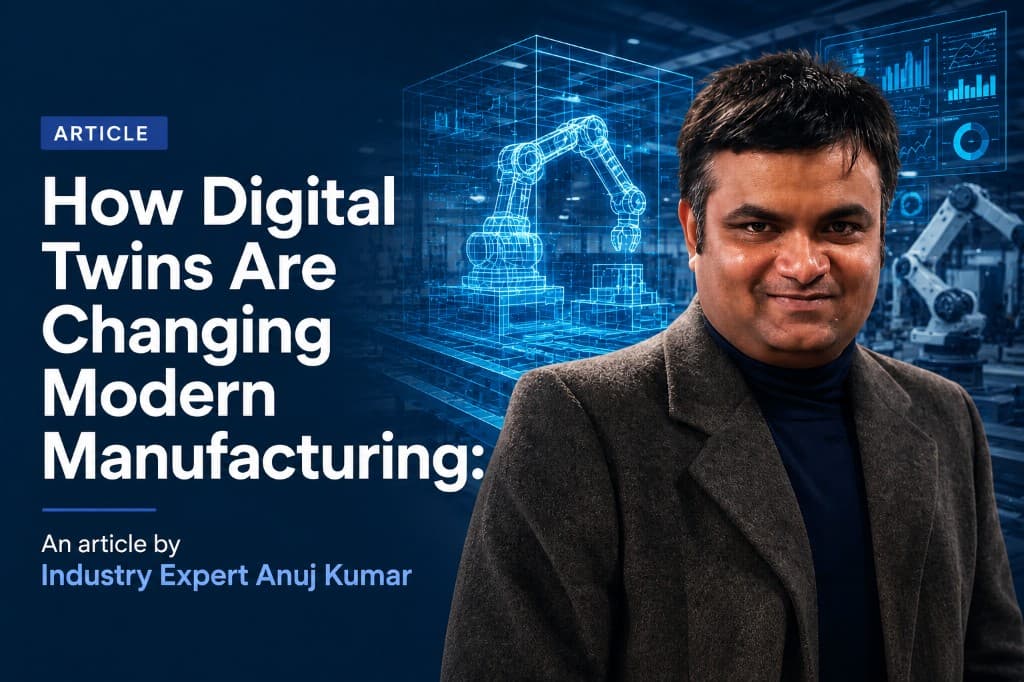
In Modern world, Manufacturing is becoming more connected, more data-driven and more responsive. One of the most important developments behind this shift is the digital twin, a virtual representation of a physical machine, process, or production system that updates in real time using operational data. By linking the digital and physical worlds, digital twins help engineers understand performance more clearly, predict problems earlier and improve processes with greater precision.
In smart manufacturing, this capability is especially valuable. Traditional production systems were often optimized for stability and scale, but not always for adaptability. Digital twin-based systems make it possible to monitor variation as it happens, simulate alternative responses and optimize operations without disrupting production. The result is a more intelligent manufacturing environment, one that supports better quality, reduced downtime, lower waste, and stronger overall efficiency.
This approach is particularly relevant in aerospace, automotive, and industrial engineering, where small variations can have major consequences. In aerospace applications, digital twins can support test systems, validation processes, and performance monitoring for complex components and assemblies. In automotive and industrial settings, they can help improve manufacturability, track process drift and support predictive maintenance. Across sectors, the value lies in the same principle: better decisions come from better visibility.
My own engineering experience has reinforced that principle across multiple projects in aerospace, automotive and industrial manufacturing systems. Work involving aircraft primary structures, interiors, test stands, data acquisition systems, digital engineering support, tooling layouts and product standardization has shown how important it is to design systems that are not only functional, but also measurable, adaptable, and efficient. The most effective engineering solutions are often those that can be monitored, analyzed, and improved continuously.
My publication work follows the same technical direction. Topics such as predictive maintenance, digital twin-based manufacturing, production automation, machining optimization, and defect reduction in additive manufacturing reflect a consistent interest in improving how engineering systems perform in practice. These areas are all connected by a common goal: to make manufacturing smarter, more reliable, and more responsive to real-world conditions.
What makes digital twin technology especially compelling is its ability to support improvement across the full lifecycle of a system. During design, it helps validate ideas earlier. During production, it helps identify inefficiencies and reduce variation. During operation, it supports condition monitoring, predictive maintenance, and performance optimization. In this way, digital twins do not just improve one stage of manufacturing but they strengthen the entire process.
For mechanical engineers, this represents a meaningful evolution in the profession. The role is no longer limited to designing parts or systems in isolation. It now includes understanding how those systems behave over time, how data can guide better decisions and how digital tools can be used to improve performance at scale. That is what makes digital twin-based smart manufacturing such an important direction for the future.
As industries continue to seek greater efficiency, flexibility and resilience, digital twin technology will play an increasingly central role. It offers a practical way to connect engineering design with operational intelligence and it gives organizations the tools they need to build better systems, faster and more effectively.
For engineers working across aerospace, automotive and industrial domains, this is more than a trend. It is a natural extension of the work of building systems that are precise, dependable and ready for the demands of modern manufacturing.
Author
Anuj Kumar
Mechanical Engineering Manager specializing in thermal systems, fluid system design, predictive maintenance, and advanced manufacturing technologies.
This article is based on author’s research “Digital Twin-Based Smart Manufacturing Systems for Real-Time Process Optimization” published in “International Journal of Engineering, Research and Development (IJERD)”, 2014, Volume: 10, Issue: 5, PP 65-72 and professional work in mechanical engineering systems, applied thermal and manufacturing technologies.
Edited by Sikkim Global Technical University Research Office
Related Stories

Keeping EV Batteries Cool: A Practical Look at Phase Change Material Thermal Systems
This article examines engineering strategies and practical industry approaches for effective thermal management of electric vehicle (EV) battery systems. It highlights the critical…
Read More >>
Intelligent Process Optimization for Defect Reduction in Metal Additive Manufacturing Using Machine Learning
This article explores the transformative potential of combining engineering principles with advanced machine learning techniques to improve defect control in metal additive manufac…
Read More >>
Intelligent Predictive Maintenance of Industrial Machinery Using Data Fusion and Machine Learning for Enhanced Reliability and Efficiency
In this article, Mr. Kumar highlights the growing importance of predictive maintenance as a critical advancement in modern engineering. He illustrates how data-driven approaches an…
Read More >>