


Additive Manufacturing
Intelligent Process Optimization for Defect Reduction in Metal Additive Manufacturing Using Machine Learning
This article explores the transformative potential of combining engineering principles with advanced machine learning techniques to improve defect control in metal additive manufacturing. It highlights how datadriven approaches can enhance process reliability, leading to smarter, more adaptive and highly efficient production systems. Drawing on both his research and industry experience, the article reflects a practical approach to advancing manufacturing technologies by connecting real-world engineering challenges with innovative, research-based solutions.
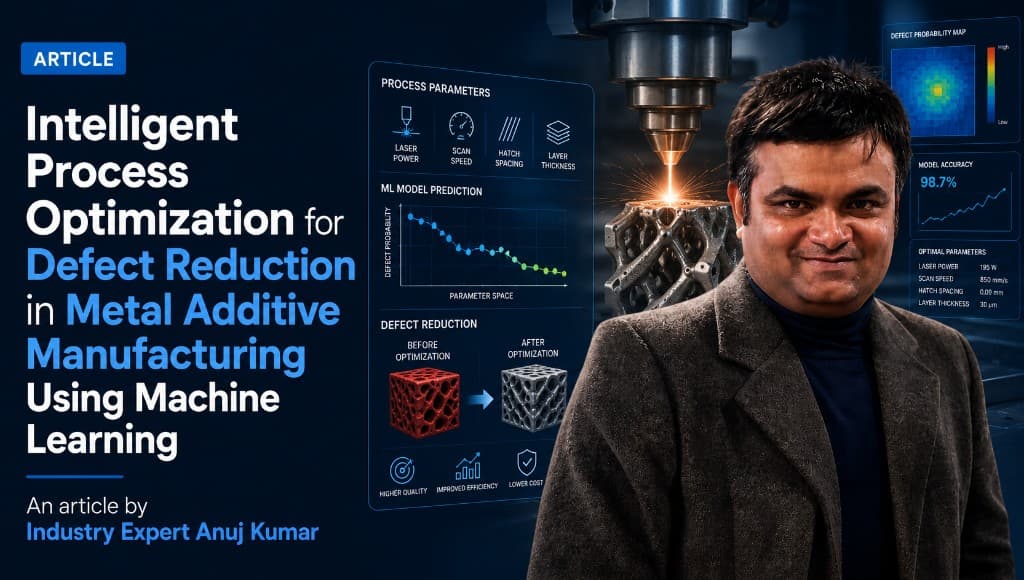
Metal additive manufacturing has opened up new possibilities for producing complex components that are difficult or sometimes impossible to manufacture using conventional techniques. This is especially relevant in industries such as aerospace and high-performance engineering, where lightweight structures, design flexibility and precision are critical.
Through my experience working on aircraft structures and interior systems for programs such as Airbus A380, A350, Airbus UK, fuselage & wing components and Piaggio Aerospace MPA platforms, I’ve seen firsthand how demanding these requirements can be. Whether it’s structural components or cabin systems, even small material defects can significantly impact performance, safety and long-term reliability.
This is why defect control remains one of the most important challenges in advanced manufacturing and increasingly, in metal additive manufacturing.
Understanding the Defect Problem
Metal 3D printing processes such as Selective Laser Melting (SLM) and Direct Metal Laser Sintering (DMLS) build components layer by layer using a focused heat source. While this enables high geometric flexibility, it also introduces complex thermal behavior.
Common defects include
Cracking, driven by thermal stresses
Incomplete fusion, where layers fail to bond properly
Residual stresses and distortion, affecting dimensional accuracy
In aerospace applications specially related to primary structures, components like fuselage frames, wing ribs are often subjected to high loads and strict certification requirements. Even small defects can lead to failure risks, which makes process control absolutely critical.
- Porosity, which reduces structural strength
The Role of Process Parameters
One of the main reasons defect control is difficult in additive manufacturing is the large number of process parameters involved.
Key variables include
Scan speed
Layer thickness
Hatch spacing
Build orientation
These parameters interact in complex ways.
- Laser power
For example
Increasing laser power improves fusion but may introduce overheating
Increasing scan speed reduces thermal exposure but can cause incomplete bonding
Changing layer thickness affects both production time and structural strength
From an engineering perspective, this is similar to challenges faced in traditional aerospace design work, where multiple variables must be balanced carefully to achieve optimal performance.
From Trial-and-Error to Data-Driven Optimization
Traditionally, engineers relied on trial-and-error to identify optimal parameters. However, this approach becomes inefficient when dealing with complex interactions.
In my research work on
“Optimization of Process Parameters in Metal Additive Manufacturing for Defect Reduction Using Machine Learning”
I explored a more structured approach using data-driven techniques and machine learning models.
Instead of manually testing combinations, this approach
Identifies relationships between inputs and outputs
Predicts defect formation
This allows engineers to optimize process parameters systematically, significantly improving efficiency and accuracy.
- Collects process data
Using Machine Learning for Defect Prediction
Machine learning methods such as
Support Vector Machines (SVM)
can analyze complex interactions between process variables.
- Artificial Neural Networks (ANN)
These models help
Identify optimal parameter ranges
Reduce uncertainty in manufacturing
In practice, this means fewer failed builds, less rework and better quality control.
- Predict defect likelihood
Combining Engineering Knowledge with Data
While machine learning is powerful, it must be combined with engineering fundamentals.
Thermal modeling, for example, helps understand
Cooling rates
Heat distribution
In both my research and engineering experience, the most effective solutions come from combining physics-based understanding with data-driven insights.
- Melt pool behavior
Real-World Engineering Impact
From a practical standpoint, smarter process control provides clear benefits:
Reduced Material Waste: High-cost materials used in aerospace and advanced systems can be utilized more efficiently.
Improved Quality and Consistency: Critical for applications where safety and certification are key requirements.
Enhanced Reliability: Defect reduction directly improves structural performance and lifespan.
Faster Development Cycles: Less trial-and-error means quicker transition from design to production.
Balancing Innovation with Practical Constraints
In real engineering projects, whether designing aircraft structures or managing manufacturing systems, solutions must balance:
Cost
Manufacturability
Reliability
From my experience working across aerospace structures and system-level engineering projects, successful solutions are rarely about using a single technique. Instead, they involve integrating multiple approaches effectively.
This same principle applies to additive manufacturing, data-driven models must be practical enough to implement in real production environments.
- Performance
Future of Additive Manufacturing
The future of metal 3D printing is moving toward more intelligent and adaptive systems.
Key trends include
Closed-loop process control
Digital twin-based optimization
Integration of AI-driven systems
- Real-time monitoring using sensors
These advancements will enable manufacturing systems to
Adjust parameters dynamically
Continuously improving performance
Engineering Perspective
From a broader mechanical engineering perspective, this field reflects a major shift:
From static processes to adaptive manufacturing
- Detect defects early
- From manual optimization to intelligent systems
It also highlights the growing need to combine
Heat transfer
Data science
Mechanical system design
- Materials engineering
Conclusion
Defect control in metal additive manufacturing is a complex but critical challenge, especially for high-performance industries such as aerospace.
Through both my engineering experience in aircraft system design and my research in machine learning-based process optimization, it is clear that traditional approaches are no longer sufficient.
By leveraging data-driven techniques alongside strong engineering fundamentals, it is possible to significantly improve manufacturing outcomes, reducing defects, improving reliability, and enabling scalable production.
As additive manufacturing continues to evolve, smarter process control will be essential in unlocking its full potential for next-generation engineering applications.
Author
Anuj Kumar
Mechanical Engineering Manager specializing in thermal systems, fluid system design, predictive maintenance, and advanced manufacturing technologies.
This article is based on author’s research published in “International Journal of Engineering Research and Science & Technology (IJERST)”, 2018, Volume: 14, Issue: 1, PP 41-60 and professional work in mechanical engineering systems, applied thermal and manufacturing technologies.
Edited by Sikkim Global Technical University Research Office
Related Stories

How Digital Twins Are Changing Modern Manufacturing
This article by Anuj Kumar explores the transformative impact of digital twin technology on modern manufacturing. He explains how the integration of digital systems and real-time d…
Read More >>
Keeping EV Batteries Cool: A Practical Look at Phase Change Material Thermal Systems
This article examines engineering strategies and practical industry approaches for effective thermal management of electric vehicle (EV) battery systems. It highlights the critical…
Read More >>
Intelligent Predictive Maintenance of Industrial Machinery Using Data Fusion and Machine Learning for Enhanced Reliability and Efficiency
In this article, Mr. Kumar highlights the growing importance of predictive maintenance as a critical advancement in modern engineering. He illustrates how data-driven approaches an…
Read More >>