


Thermal Engineering
Keeping EV Batteries Cool: A Practical Look at Phase Change Material Thermal Systems
This article examines engineering strategies and practical industry approaches for effective thermal management of electric vehicle (EV) battery systems. It highlights the critical role of advanced cooling technologies in improving battery performance, safety and long-term durability in modern electric mobility. Supported by Mr. Kumar’s work in extensive research and professional experience in real-world engineering applications, the article emphasizes how integrating fundamental engineering principles with practical implementation can lead to reliable, high-performance thermal management solutions. It further illustrates how these approaches help improve energy efficiency, extend battery life and address key challenges in EV battery technology, making thermal management a vital component of next-generation electric vehicle systems.
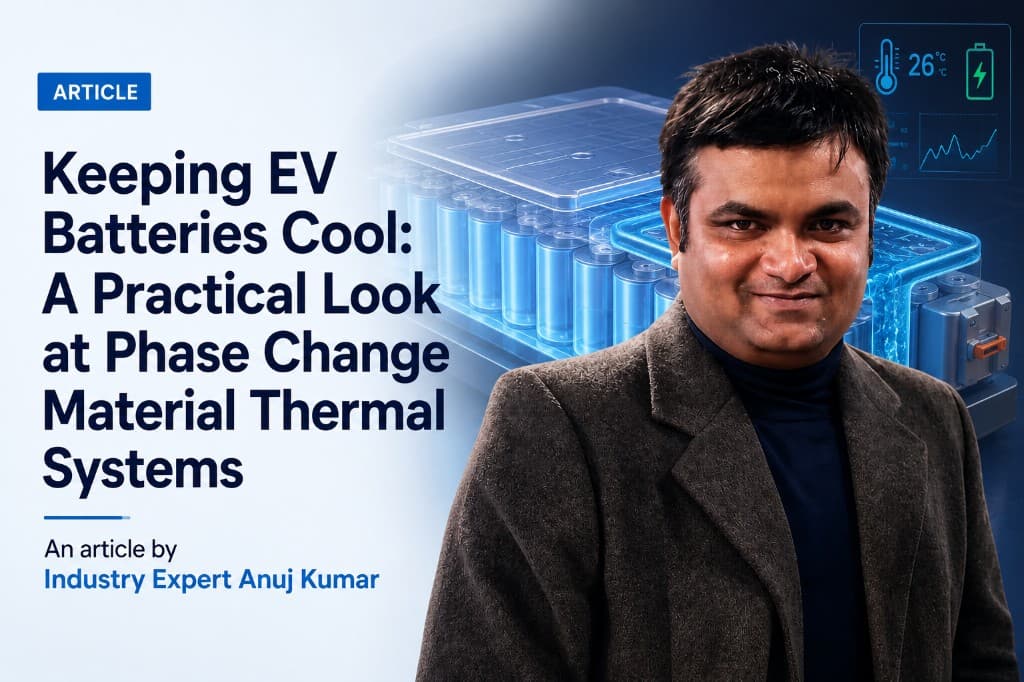
Electric vehicles rely heavily on battery performance and that performance is directly tied to temperature. If a battery gets too hot, it can lose efficiency, degrade faster and become less reliable over time. On the other hand, if it gets too cold, it struggles to deliver power and takes longer to charge. Because of this, maintaining the right temperature range is one of the most important challenges in EV design.
In both my professional work as a Mechanical Engineering Project Manager and my research on “Battery thermal management using Phase Change Materials” I’ve seen how critical thermal control is to overall system performance. It’s not just a design detail but it often defines how well the system actually works in real-world conditions.
In several engineering projects I’ve been involved in, especially those dealing with high-performance fluid and thermal systems, managing localized heat buildup and ensuring stable operating conditions has been a recurring challenge. These experiences directly shaped my interest in more efficient and reliable thermal management approaches.
One practical solution to this problem is the use of phase change materials (PCMs).
A phase change material works by absorbing or releasing a large amount of heat when it changes state, typically from solid to liquid and back again. This property makes it very useful for battery systems. Instead of letting heat to build up quickly during charging or high load operation, a PCM can absorb that excess heat and slow down temperature rise, helping keep the battery more stable.
What makes PCMs particularly appealing is that they work passively. Unlike traditional cooling systems, they don’t always need pumps, fans or complex control systems to start working. From my experience working on complex engineering systems, reducing system complexity is often just as important as improving performance. This can simplify the overall design, reduce noise and make better use of available space. A simpler thermal solution can mean lower cost, better reliability, and easier integration, especially in EVs where space and weight are always constrained.
Another benefit is how they help manage temperature across the battery pack. In real systems, not all battery cells heat up evenly. These temperature differences can lead to uneven performance and faster wear in certain cells. By absorbing and distributing heat more effectively, PCMs help create a more uniform temperature profile, which improves overall system stability and battery life.
That said, PCMs are not a perfect solution on their own. Their performance depends heavily on choosing the right material and integrating it properly into the system. For example, if the material doesn’t conduct heat well, it may not absorb heat quickly enough. And in situations with continuous high power, it can eventually become saturated. That’s why many practical designs combine PCMs with other cooling methods, like heat sinks, heat pipes, or liquid cooling, to create a more balanced and effective system.
In the projects I’ve managed, similar hybrid strategies are commonly used to balance performance with real-world constraints such as packaging, cost, and reliability. The best solutions are rarely single-method approaches, they are typically optimized combinations.
From a broader mechanical engineering perspective, battery thermal management brings together multiple disciplines:
Material selection
System design
Testing and validation
It also reflects a larger shift in the industry. Modern vehicles are becoming more electrified and more dependent on precise thermal control than ever before. The margin for errors is smaller and the expectations for performance and safety are higher.
From an engineering standpoint, this is what makes battery thermal management so interesting. It’s not just about preventing overheating, it’s about designing a system that performs reliably under real-world conditions, including fast charging, changing environments and long-term use.
As electric vehicles continue to grow, thermal management will remain a key area of innovation. Phase change materials offer a practical and efficient way to manage heat right where it is generated. For engineers working on next-generation battery systems, they provide a promising path toward safer, more reliable, and more efficient electric vehicles.
- Heat transfer
Author
Anuj Kumar
Mechanical Engineering Manager specializing in thermal systems, fluid system design, predictive maintenance, and advanced manufacturing technologies.
This article is based on author’s research published in “International Journal of Engineering Science and Mathematics (IJESM)”, 2021, Volume: 10, Issue: 3 and professional work in mechanical engineering systems, applied thermal and manufacturing technologies.
Edited by Sikkim Global Technical University Research Office
Related Stories
How Digital Twins Are Changing Modern Manufacturing
This article by Anuj Kumar explores the transformative impact of digital twin technology on modern manufacturing. He explains how the integration of digital systems and real-time d…
Read More >>
Intelligent Process Optimization for Defect Reduction in Metal Additive Manufacturing Using Machine Learning
This article explores the transformative potential of combining engineering principles with advanced machine learning techniques to improve defect control in metal additive manufac…
Read More >>
Intelligent Predictive Maintenance of Industrial Machinery Using Data Fusion and Machine Learning for Enhanced Reliability and Efficiency
In this article, Mr. Kumar highlights the growing importance of predictive maintenance as a critical advancement in modern engineering. He illustrates how data-driven approaches an…
Read More >>